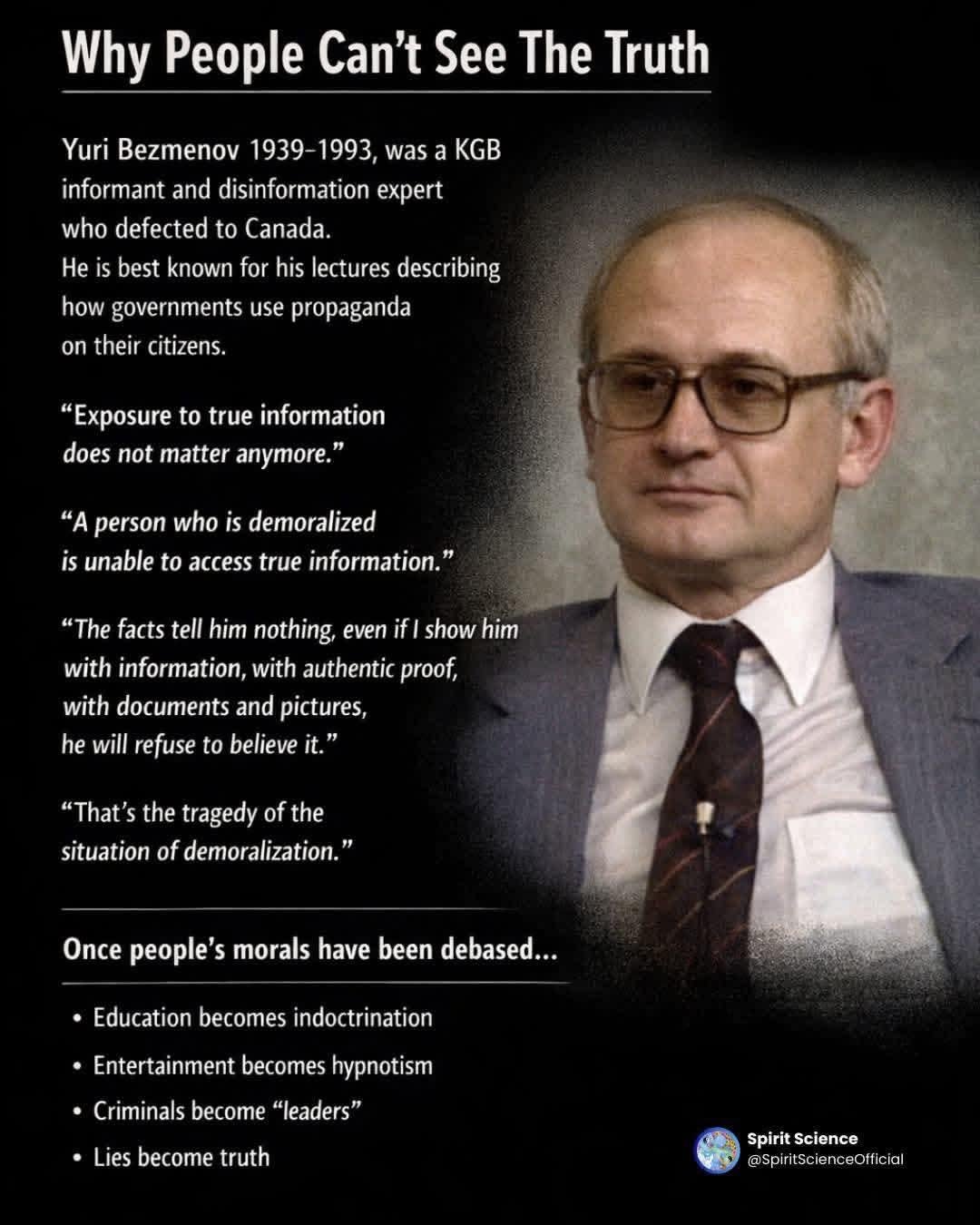
When Yuri Besmenov was interviewed by Griffin in 1984, he explained the concept of ideological subversion and the various stages.
1. Demoralization (15–20 Years)
• Definition: The systematic undermining of a society’s moral, ethical, and cultural foundations.
• Goal: To change the mindset of a generation so that even with access to truthful information, they are incapable of assessing it objectively.
• Methods: Infiltration of educational institutions, media, and cultural platforms to promote disillusionment and challenge traditional values.
• Timing: This takes roughly 15 to 20 years, which is the time required to educate one generation.
2. Destabilization (2–5 Years)
• Definition: The weakening of essential structural elements of a nation.
• Goal: To create instability in key areas, making the society vulnerable.
• Targeted Areas: The economy, foreign relations, and defense systems.
• Methods: Overt, often legitimate actions that cause chaos, such as damaging public trust in government or disrupting economic stability.
3. Crisis (Up to 6 Weeks)
• Definition: A violent change in power, structure, and the economy.
• Goal: To create a situation where the society is on the brink of collapse, necessitating a "strong hand" or radical change.
• Outcome: The population, tired of chaos, is forced to accept a new ideology and leadership.
4. Normalization (Indefinite)
• Definition: The final stage where the target nation is effectively taken over and brought under new control.
• Goal: To stabilize the country under a new, often Marxist-Leninist or authoritarian, reality.
• Outcome: The "subverters" (who initiated the process) are often removed, as they are no longer needed, and a new, repressive order is established.
Key Contextual Points:
• "Useful Idiots": Bezmenov often referred to people in the West who aided this process unknowingly as "useful idiots"—people who believe they are fighting for a righteous cause but are actually working to destroy their own society.
• Active Measures: The KGB term for this form of psychological warfare and propaganda.
• Long-Term Strategy: Bezmenov emphasized that because these stages take decades, the average person cannot perceive the consistent, willful effort behind it.
When Yuri Besmenov was interviewed by Griffin in 1984, he explained the concept of ideological subversion and the various stages.
1. Demoralization (15–20 Years)
• Definition: The systematic undermining of a society’s moral, ethical, and cultural foundations.
• Goal: To change the mindset of a generation so that even with access to truthful information, they are incapable of assessing it objectively.
• Methods: Infiltration of educational institutions, media, and cultural platforms to promote disillusionment and challenge traditional values.
• Timing: This takes roughly 15 to 20 years, which is the time required to educate one generation.
2. Destabilization (2–5 Years)
• Definition: The weakening of essential structural elements of a nation.
• Goal: To create instability in key areas, making the society vulnerable.
• Targeted Areas: The economy, foreign relations, and defense systems.
• Methods: Overt, often legitimate actions that cause chaos, such as damaging public trust in government or disrupting economic stability.
3. Crisis (Up to 6 Weeks)
• Definition: A violent change in power, structure, and the economy.
• Goal: To create a situation where the society is on the brink of collapse, necessitating a "strong hand" or radical change.
• Outcome: The population, tired of chaos, is forced to accept a new ideology and leadership.
4. Normalization (Indefinite)
• Definition: The final stage where the target nation is effectively taken over and brought under new control.
• Goal: To stabilize the country under a new, often Marxist-Leninist or authoritarian, reality.
• Outcome: The "subverters" (who initiated the process) are often removed, as they are no longer needed, and a new, repressive order is established.
Key Contextual Points:
• "Useful Idiots": Bezmenov often referred to people in the West who aided this process unknowingly as "useful idiots"—people who believe they are fighting for a righteous cause but are actually working to destroy their own society.
• Active Measures: The KGB term for this form of psychological warfare and propaganda.
• Long-Term Strategy: Bezmenov emphasized that because these stages take decades, the average person cannot perceive the consistent, willful effort behind it.









 English
 Arabic
 French
 Portuguese
 Deutsch
 Turkish
 Dutch
Dutch
 Italiano
 Russian
 Romaian
 Portuguese (Brazil)
 Greek
Greek